Every year people say that email marketing is dead. The truth is that the numbers do not agree with this. Email marketing is still doing well. That's probably because email isn't as flashy as a TikTok video or as instant as a Google ad. It seems old compared to the platforms that are popular now. When you look at how much money email marketing actually makes it is still doing better than most other things that companies spend money on to market themselves. This happens every year no matter which social platform is popular at the time. Email marketing is still the best, year after year. It keeps making money for companies that use it.
Here's what the 2026 data actually shows, what a real email program costs to run, and why it's become one of the more strategically important channels in the AI-search era, not less a point that gets buried in most "is email still worth it" articles.
Why Email Still Wins on ROI
The big number is that email marketing gives you $36-$42 for every $1 you spend on average in 2026. This is especially true for e-commerce brands, which can get up to $45. Email marketing is three times better than local SEO and almost five times better than Google Ads. Nothing else is as good as email marketing. For years people have said that some new platform would be better but email marketing is still the best.

The reason is simple once you think about it: you're not paying to reach strangers. You're emailing people who already gave you permission to contact them past customers, newsletter subscribers, people who abandoned a cart. That's about as warm an audience as marketing gets, and warm audiences convert dramatically better than cold ones. It's also worth noting how consistent this number is: unlike a lot of marketing statistics that swing wildly year to year, email's ROI has sat in roughly the same $36-$42 range across multiple independent studies for several years running, which makes it one of the more trustworthy figures in the entire industry.
The Emails That Actually Work
Email is not all the same. The numbers show this. People usually open emails around 50-60% of the time. This is really high compared to newsletters. When people leave things in their shopping cart and we send them an email we get 30-40% of those sales back. We also send emails to people who have not bought anything from us in a while and 15-25% of the time they start buying. Automated email flows are really good at making sales. They make up just 2% of all the emails sent but generate 37% of all the revenue from email.

The last statistic is the one that's worth remembering. Well-built automated email sequences, set up once and running quietly in the background, outperform many one-off newsletter blasts sent over several months. This is where the real return on investment for email marketing actually happens and it is also the part of email marketing that most small businesses do not do well even though setting it up only has to be done one time and does not take up a lot of time after that.
What a Real Email Program Costs
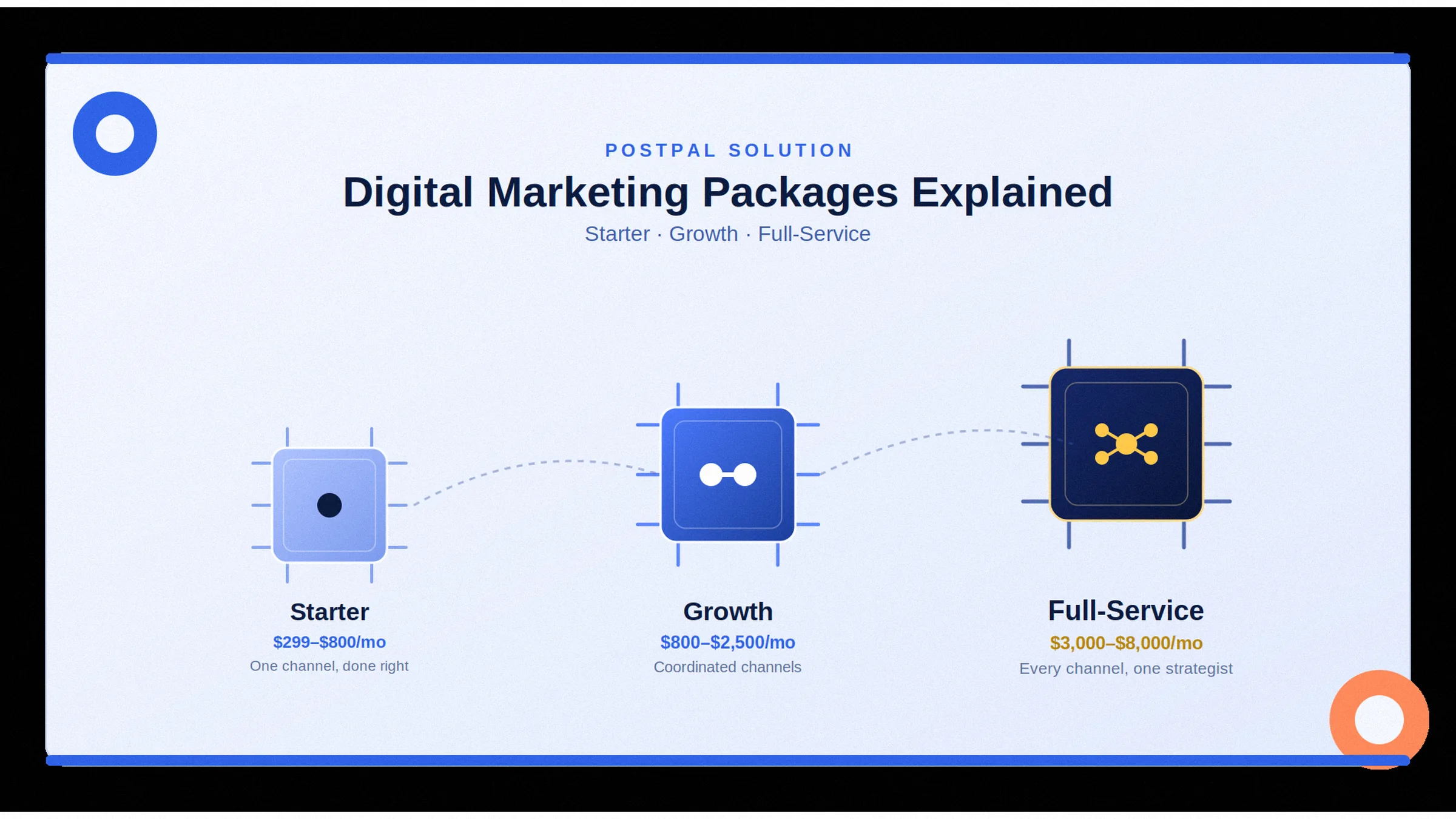
Entry-level email tools and light management run $50-$300/month. A properly built program segmentation, automated flows, a real newsletter cadence, and monthly reporting typically runs $500-$2,000/month depending on list size and complexity. PostPal's Email Marketing Campaigns service starts at $199/month, making it one of the most accessible paid channels for a business testing its first real campaign.
Given the ROI numbers above, email is one of the rare marketing line items that's genuinely hard to overspend on relative to what it returns the more common mistake is under-investing in it, or setting it up once and never touching it again. A list that never gets segmented and a welcome flow that was built two years ago and never updated will quietly underperform for years without anyone noticing, simply because nothing about email breaks in a way that forces attention the way a stopped PPC campaign does.
The Channel AI-Search Shifts Can't Touch
This is worth spelling out directly, because it's becoming one of email's biggest strategic advantages rather than a footnote. Every channel discussed elsewhere in this series, SEO, PPC, social, depends to some degree on algorithms or AI systems you don't control, and all of them are being reshaped by the rise of AI Overviews and chatbot search. Email isn't. It's a private, first-party channel: nobody's AI model decides whether your subscriber sees your message. If they opted in, it lands in their inbox, full stop.
That does not mean that email takes the place of SEO or social media. It means that email is the one part of your marketing that remains the same while everything else changes with the algorithm or artificial intelligence shift. These days, a lot of marketing channels don't feel as predictable as they did a few years ago. Because of this the fact that email stays stable is very important. The stability of email is worth more now than it was before. It's also a reason to treat your email list itself as a genuine business asset something you own outright, independent of whatever changes happen to search or social platforms next.
Common Mistakes That Kill Email ROI
- Sending generic blasts with no segmentation: Segmented campaigns see people about 6x more likely to buy compared to sending the same message to everyone.
- Skipping automation: Automated sequences create 320% more money than manual single time campaigns for the same work.
- Not tracking real numbers: When it comes to email ROI, only 1 in 8 companies feel confident they're measuring it correctly, which means most businesses aren't really sure what's working.
- Buying or renting email lists: Using lists is not a good idea because they do not convert well and can actually hurt the delivery of emails to your real subscribers who have opted in to receive emails from you.
None of these errors are hard to correct once you understand what to watch for. That's one reason email continues to provide such a return on investment even for companies that aren't doing everything right. Email is a forgiving channel, but a properly managed program still performs far better than one that's left on autopilot.
Getting Started the Right Way
Start with the highest-leverage automation first: a welcome sequence if you don't have one, or an abandoned cart flow if you sell online, before worrying about newsletter frequency. These two flows alone typically account for a disproportionate share of email revenue for a new program, and getting them right before layering on more complexity saves a lot of wasted effort. Our Digital Marketing Packages guide walks through how email typically fits into a broader package if you're bundling it with SEO or social.
From there, focus on segmentation: dividing your list based on actions someone takes or what they've bought, instead of sending the same message to everyone. It's a change in how you work that keeps showing up in the numbers as one of the main reasons why some email programs are average and others are really good.
If you prefer to handle outreach campaigns on your own instead of giving everything over to someone else it's good to know there are simpler tools made just for that. PostPalMail, for example, allows you to look up business contacts by industry and country then connect your own Gmail or SMTP to send, track and respond to campaigns all in one place. A useful option, between doing everything by hand and giving the whole project to a company.
Conclusion
The ROI data ends the "email is dead" argument clearly. It is not dead. It's still one of the best-performing channels available to a small business. It's also become more valuable, not less, as other channels get reshaped by AI search, simply because it's the one channel that's entirely yours. Take a look at PostPal's Email Marketing Campaigns service to get started, or check out the full Digital Marketing & SEO Services guide for how email fits alongside your other channels.
Disclaimer: This article is for general informational purposes only and does not guarantee specific ROI, open rates, or revenue outcomes. Figures reflect publicly available 2026 industry benchmarks and PostPal Solution's published service rates at the time of writing and are subject to change.
Frequently Asked Questions
Is email marketing really still worth it in 2026?
How much should a small business spend on email marketing?
What's the single highest-impact email to set up first?
Does email marketing help with AI search visibility?
Why do automated emails outperform regular newsletters?