This decision usually comes down to a gut feeling before it comes down to a spreadsheet: a freelancer built their site cheap and fast, or a competitor’s agency-built site looks noticeably more polished. Neither anecdote is wrong, exactly. They’re just describing two different risk profiles, and picking the one that matches your actual project matters more than picking the one with the better story attached to it.
What You’re Really Choosing Between
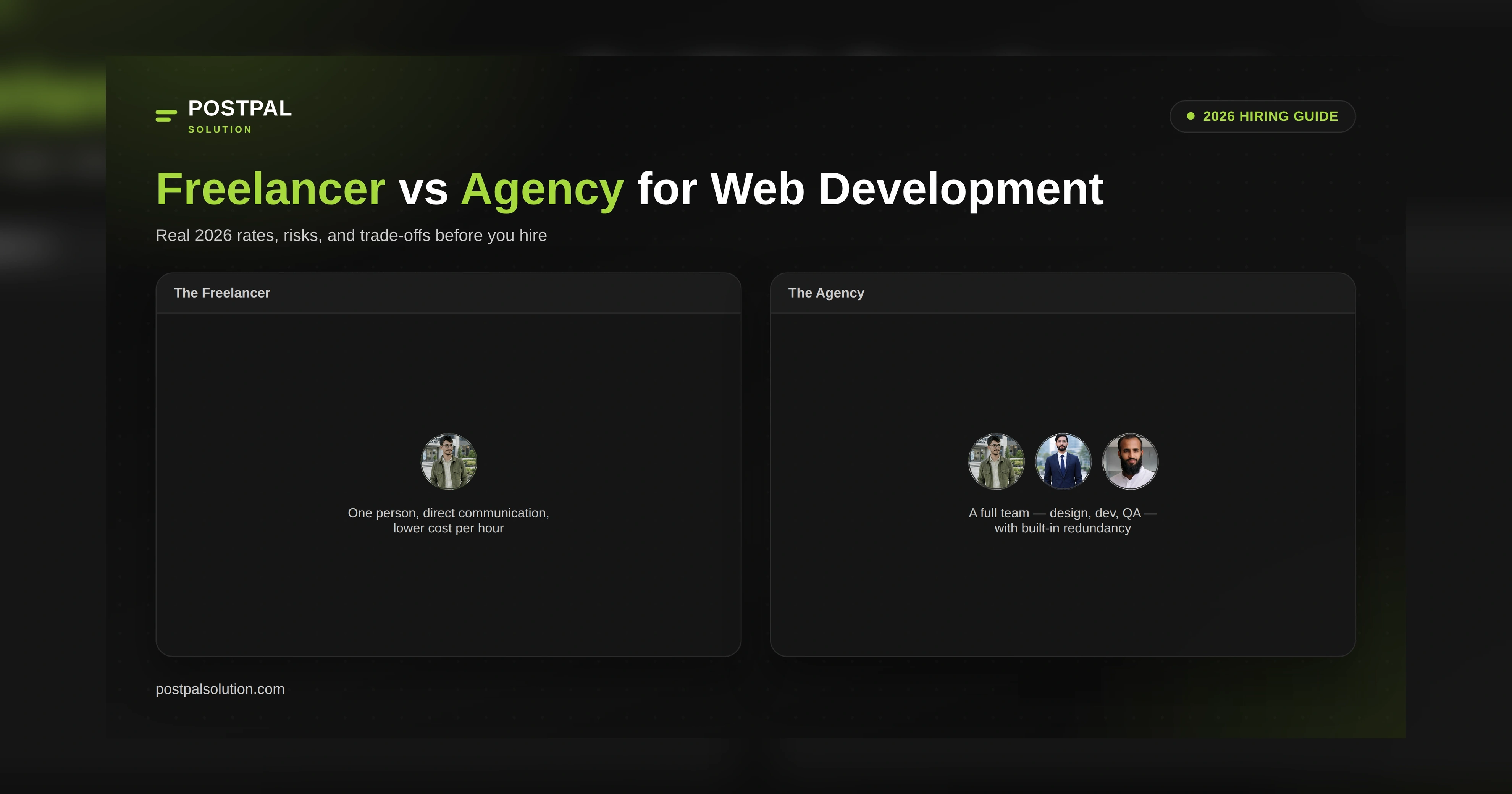
A freelancer is one person, working directly with you, usually charging less per hour because there’s no team overhead behind the number. An agency is a structure: a project manager, a designer, one or more developers, and usually someone handling QA, charging more per hour because you’re paying for that structure, not just the code.
That structure is the whole trade-off in one sentence. A freelancer gives you speed, direct communication, and a lower bill for well-scoped work. An agency gives you redundancy, process, and a team that can absorb specialties a single person usually can't cover well. Design, development, and SEO rarely live at expert level in the same person.
What Each One Actually Costs

For an exact estimate on your specific project, see our 2026 rates by project type before comparing quotes.
Type Freelancer Agency Typical hourly rate $15–$60/hr $40–$150/hr Small marketing site (5 pages) $400–$2,000 $750–$4,000 Mid-size business site $1,500–$5,000 $2,500–$8,000 Ongoing maintenance/updates $15–$40/hr $40–$80/hr Typical time to start Days 1–3 weeks (discovery, proposal)
For a small, well-defined project, a freelancer can genuinely save 40–60% over an agency quote for comparable scope. That gap narrows or disappears on complex builds; a freelancer working alone on a project that really needs a designer, a developer, and a QA pass either takes much longer to finish all three roles or quietly skips one of them.
Where Freelancers Win
Freelancers are really good when it comes to saving money on projects that are easy to understand, like making a landing page or a small website or changing a WordPress theme. You get to talk to the person who is actually doing the work, so you do not have to go through someone to get updates. A lot of freelancers are available when regular businesses are not, which is helpful if you are in a part of the world or need something done quickly. Freelancers who have been working for a time and used to work for big companies can do work that is just as good as what a big company can do, at least when it comes to the things they are really good at.
Where Agencies Win
Agencies handle the parts of a project you can't see but that matter later, the things freelancers often skip. This includes making sure the project works on different devices and browsers, following accessibility rules, making the project secure, and providing help after the project is finished. A lot of freelancers skip these things, not because they do not care. One person cannot be an expert in design, development, testing, search engine optimization, and support all at the same time. Agencies also solve the continuity problem freelancers create. If one team member is unavailable, sick, or leaves mid-project, someone else steps in and the work continues without stopping.
When Each One Actually Wins
 When you know exactly what you want, and it's not going to change, a freelancer is a good choice. This is because one person can do the design and development work when the site is simple. Your budget for the project should be around $5,000 to $8,000 (check current rates by project type to see where your project lands), and you also have to be okay with talking to the freelancer without someone else in the middle to manage the project. Choose a freelancer for your project when these things are true.
Choose an agency when the project touches multiple disciplines: real design work, custom development, SEO, and content that all need to work together. Choose one when the website is business-critical and downtime or bugs are expensive, when you want predictable delivery without managing developers day to day, or when ongoing support after launch matters as much as the initial build.
The Risk Most People Underestimate
The biggest freelance risk isn’t skill; plenty of freelancers are excellent. It’s continuity. If a freelancer gets busy with another client, has a personal emergency, or simply moves on to something else, there’s no backup plan, and your recourse against an individual is weaker than it is against a company with a real contract and reputation on the line. Three things protect against this regardless of who you hire: pay in milestones tied to specific deliverables rather than a lump sum, get a written contract covering IP ownership and source code handover, and confirm a defined post-launch bug-fix window before work starts.
Conclusion
Neither option is universally right. The honest answer depends on how well-defined your project is, how much it would cost you if something breaks, and whether you want to manage the work directly or hand it to a team. Match the choice to those three things and you’ll avoid the two most common regrets: overpaying an agency for a project simple enough for a strong freelancer, or underestimating what a “simple” project actually needed.
If you’re weighing this decision for your own project, PostPal Solution can scope it honestly and tell you which approach actually fits. Visit our Web Design & Development service page to talk it through, or compare current pricing for both before you request quotes elsewhere.
Disclaimer: The real price you pay depends on who you hire, how complex your project is, and where you're located, so it may differ from the amounts listed here. This article is for general information only and isn't a promise of a specific price. Contact PostPal Solution directly to get pricing for your project.
Frequently Asked Questions
Is it always cheaper to hire a freelancer than an agency?
What’s the biggest risk of hiring a freelancer?
Can a freelancer really match agency-level quality?
Should I hire multiple freelancers instead of one agency?
At what budget does an agency make more sense than a freelancer?