You didn't come here to read a dictionary definition of branding. You came here because you are looking at quotes from agencies. You are scrolling through a freelancer’s portfolio. You are trying to figure out if the big jump from a $300 logo to a $15,000 brand identity package is actually about quality. Maybe you are wondering if the price gap is just about who is better, at selling branding. That is a question and I want to give you a straight answer.
Branding is one of those marketing investments that keeps paying you back long after you pay the invoice. When you have a logo you're truly proud of, you'll use it for years: on your website, your packaging, your social profiles, your signage, and every pitch deck you ever send. That's because people recognize your brand faster, trust it sooner, and remember it even after they close the tab.
The problem is that "graphic design and branding" covers a huge range in 2026, from a $10 AI-generated logo to a six-figure agency rebrand. And most guides either simplify it to "just get a logo made" or fill it with agency jargon that doesn't help you make any decisions. This guide explains the category the way we help real clients at PostPal Solution: what things actually cost right now, what makes a logo different from a full brand identity, when DIY makes sense and when it costs you more later, and how to choose the right partner and package for your business stage.
Use the list below to jump to what you need or read through from the top if you're starting from zero.
What You'll Learn
● How Much Does Logo Design Cost in 2026? (Pricing Breakdown)
● Logo Design vs Full Brand Identity: What's the Difference?
● DIY Logo vs Professional Designer: Is It Worth the Investment?
● What's Included in a Brand Identity Package?
● Why Consistent Social Media Graphics Matter for Small Business
● Case Study: How a Rebrand Helped a Client Stand Out in a Crowded Market
● How to Choose a Graphic Designer for Your Business
● Print vs Digital Design: What Small Businesses Actually Need
● 5 Signs It's Time to Rebrand Your Business
● Brand Identity Packages Explained: Which One Fits Your Business?
1. How Much Does Logo Design Cost in 2026? (Pricing Breakdown)
Logo pricing in 2026 splits into four clear brackets, and knowing which one you're in matters more than knowing the raw number. AI logo makers and template tools cost $0 to $100 and give you only a basic placeholder, nothing else. Freelance designers typically charge $300 to $2,500, which is where most small businesses go for a genuinely custom result. Freelance designers give you custom concepts, a real revision process, and proper file formats, instead of a single PNG.
We put a price on a logo project from $500 to $5,000. The price changes if a studio or agency does a lot of discovery work and builds a full system, or if a large agency also names the brand, positions it, and launches it across multiple markets. Small businesses usually spend $500 on a logo project. Some small businesses spend between $1,000 and $2,500 on a logo that needs to hold up in a competitive market. If you only care about the price now our pricing page shows clear logo project packages instead of vague ranges.
Read the full guide: How Much Does Logo Design Cost in 2026? (Pricing Breakdown)
2. Logo Design vs Full Brand Identity: What's the Difference?
A logo is one file. A brand identity is the entire system that file has to live inside: the color palette with exact hex and CMYK codes, the typography pairing for headings and body text, the patterns and icon style, and a guidelines document that tells anyone touching your brand how to use all of it correctly. Businesses that buy "just a logo" often end up rebuilding the rest piece by piece over the following year anyway, usually at a higher total cost than if they'd bought the system up front.
The mix-up between the two words is where most of the frustration in this area happens. A customer who believes they are getting a brand and only gets a logo file feels like they didn't get what they paid for even if the designer gave exactly what was agreed on. Clarifying this difference before you ask for prices is the way to compare companies honestly.
Read the full guide: Logo Design vs Full Brand Identity: What's the Difference?
3. DIY Logo vs Professional Designer: Is It Worth the Investment?
DIY tools have genuinely improved, and for a business that's still validating an idea, a free or low-cost logo can be a reasonable placeholder. The trade-off shows up later: template-based marks are rarely trademarkable, rarely scale cleanly across formats, and rarely hold up once a business starts producing real marketing volume: packaging, signage, paid ads, a proper website.
A professional designer cost’s more at first. The designer builds in the thinking that a template cannot. The designer creates a mark that works in color, fits on a business card, and looks good on a billboard. The designer also gives files ready for every use case, from the beginning. That difference shows up directly in how trustworthy a brand looks the moment a prospect encounters it.
Read the full guide: DIY Logo vs Professional Designer: Is It Worth the Investment?
4. What's Included in a Brand Identity Package?
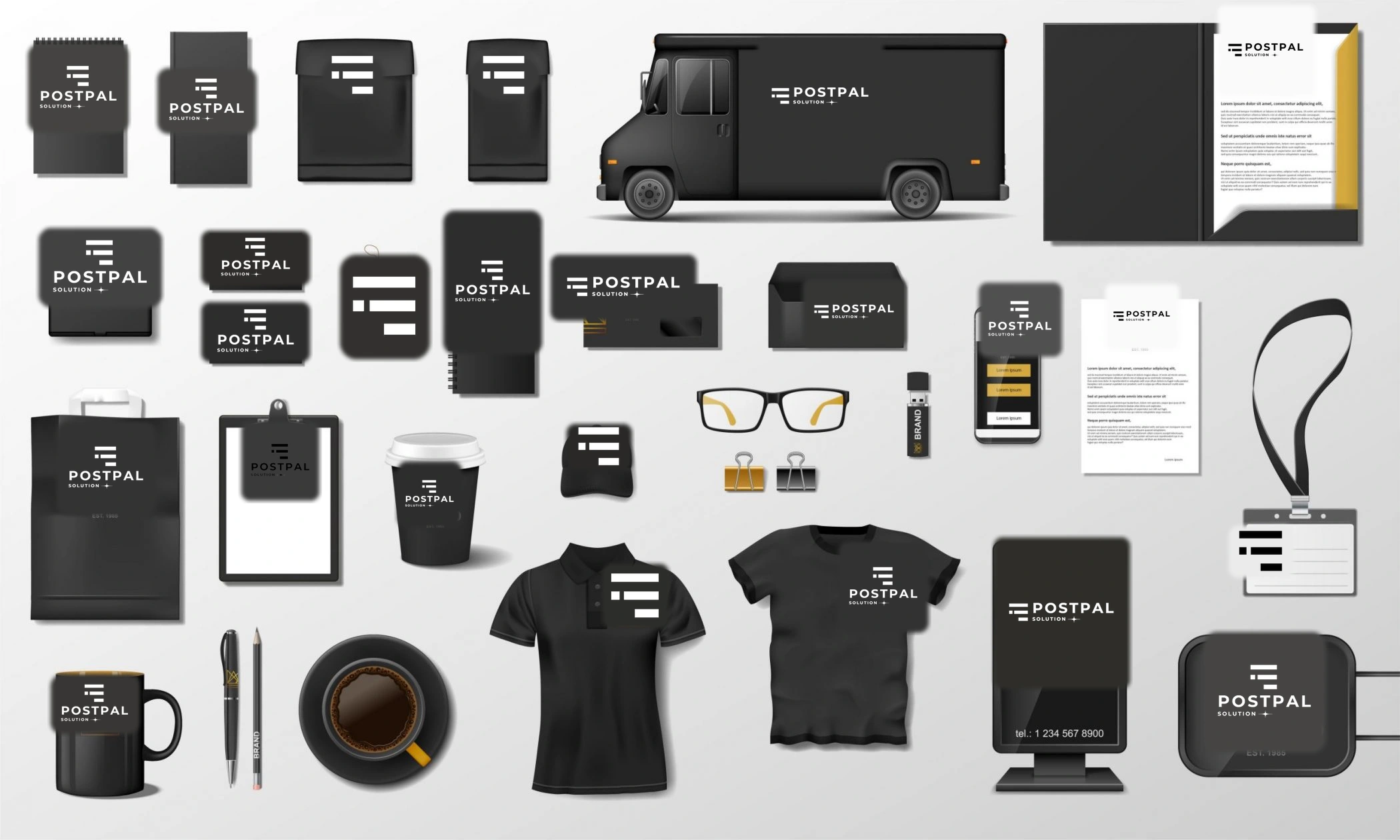
A strong brand identity package includes six things: a logo system with main and backup versions, a full color system with usage rules, a font pairing, a set of patterns or icons, a written brand guidelines document, and a starting set of materials like social media templates or business cards. These packages can vary a lot in how detailed they are, which is exactly why our pricing page lists each part clearly instead of giving one single price.
Knowing this list before you talk to any provider protects you from the most common branding complaint we hear from new clients: paying for what they assumed was a full package and receiving only a logo and a color swatch.

Read the full guide: What's Included in a Brand Identity Package?
5. Why Consistent Social Media Graphics Matter for Small Business
When your graphics look messy, it sends a message. If your fonts or colors change from one platform to the next, people might assume your business isn't quite in control. Consistent visual branding across every channel really matters. Businesses that keep visual branding across every channel often make much more money. This happens because people recognize your brand faster and trust grows every time someone sees your brand again.
Consistency is one of the most overlooked parts of branding, mostly because it doesn't feel as urgent as a logo redesign. Consistency is often the highest-leverage, lowest-cost fix available to a small business that already has a decent logo and just needs the rest of the output to belong to the same company.
Read the full guide: Why Consistent Social Media Graphics Matter for Small Business
6. Case Study: How a Rebrand Helped a Client Stand Out in a Crowded Market
Numbers convince business owners faster than adjectives do. This case study walks through a real rebrand engagement from the initial brand audit through to measurable results after launch: inquiry volume, perceived pricing power, and how the client's new identity performed against direct competitors in the same market. Before you hire someone, ask them how they approach discovery, how many revisions are included, what file types you'll receive at the end, and who owns the rights to the final work.
Read the full guide: Case Study: How a Rebrand Helped a Client Stand Out in a Crowded Market
7. How to Choose a Graphic Designer for Your Business
The quality of the portfolio is the test; the quality of the process is the one that really shows if a project will go well. Before you hire someone, ask them how they approach discovery, how many revisions are included, what file types you'll receive at the end, and who owns the rights to the final work. Designers who can answer all four questions without hesitation are almost always the right choice, no matter what the cost is.
The cheapest quote and the most expensive quote can both be wrong for your business. The right one is the designer whose process matches how much certainty your brand actually needs right now.
Read the full guide: How to Choose a Graphic Designer for Your Business
8. Print vs Digital Design: What Small Businesses Actually Need
Print and digital design aren't interchangeable, even though they often come from the same brand file. Print work must account for bleed, color modes such as CMYK, and the choice of material. Digital design lives in RGB and must work across many screen sizes. Logos that look great on a website can become blurry on a banner, or vibrant on a screen but dull on a printed brochure. The issue arises because the design was completed without considering the differing priorities of a business that sells online versus a business that uses signage, packaging or trade show materials.
Read the full guide: Print vs Digital Design: What Small Businesses Actually Need
9. 5 Signs It's Time to Rebrand Your Business
Many businesses wait too long to rebrand because the process feels risky or expensive. In practice, a handful of signals show that a rebrand is needed. For example: your logo looks dated next to competitors, your visuals don't match the caliber of clients you now attract, your business has pivoted since the original brand was built, or you're inconsistent across every platform you post on. Any of these means it's time for a rebrand, not just optional polish.
Catching these signs early keeps a rebrand a proactive decision rather than a reactive scramble after a competitor's new look starts pulling attention away from yours.
Read the full guide: 5 Signs It's Time to Rebrand Your Business
10. Brand Identity Packages Explained: Which One Fits Your Business?
Not every business needs the same package, and buying more than you need is just as costly a mistake as buying too little. A new business validating an idea needs a lean starter package. A growing business ready to scale marketing needs the full identity system with guidelines. An established business preparing to expand into new markets often needs strategy work layered on top of the visual system. Our pricing page maps each package tier to exactly this kind of business stage, so you're not guessing which one applies to you.
Read the full guide: Brand Identity Packages Explained: Which One Fits Your Business?
Graphic Design Pricing at a Glance
Here's how the main routes to getting your branding done compare, side by side, before you commit to any one of them.

|
Option |
Typical Price Range (2026) |
What You Actually Get |
Best Suited For |
|
DIY / AI Logo Maker |
$0 – $100 |
Template-based mark, minimal customization, no strategy or guidelines |
Pre-launch validation, placeholder branding |
|
Freelance Designer |
$300 – $2,500 |
Custom concepts, a handful of revisions, usable file formats |
Small businesses needing a professional mark on a budget |
|
Boutique Design Agency (like PostPal) |
$500 – $5,000+ |
Discovery process, full logo system, color and typography, brand guidelines, ongoing support |
Businesses that want strategy and consistency without agency overhead pricing |
|
Large / Enterprise Agency |
$15,000 – $150,000+ |
Deep research, naming, messaging, multi-market rollout, dedicated account teams |
Funded startups and large companies with complex rollout needs |
Ready to Build a Brand That Actually Converts?
Everything above is the short version of a conversation we have with new clients almost every week. If you'd rather skip the research and get a straight answer for your specific business, take a look at our graphic design and branding services or check our pricing page to see exactly what's included at each package level. PostPal Solution has worked with clients across 50+ countries, so wherever your business is based, we've likely already solved a version of the branding problem you're facing.
Conclusion
Branding isn't one decision, it's a series of smaller ones: how much to spend, whether to go DIY or professional, what a package should include, and when it's time to revisit a brand that's stopped working for you. Each cluster article linked above goes deep on one of those decisions with current pricing, real comparisons, and a clear recommendation, so you can move from "comparing options" to "confident decision" without getting lost in agency jargon along the way.