Every successful business eventually comes to the choice: make strategy decisions by themselves or bring in someone, from outside to handle it. Either option can be good. The problem is that most business owners choose one without looking at what each one offers.
This article breaks down what in-house planning and outside consulting each really offer, where they fall short, and how to tell which one fits your business right now. If you're weighing this decision against a hard number, our guide on how much a business strategy session costs in 2026 is a useful companion piece.
What "In-House Strategy" Really Means
In-house strategy means the people who are already working for you usually you, a co-founder or a senior manager decide where the business is going. There is no fee, no time when you hand things over and the person who makes the decision already understands the team the customers and the reasons, behind past choices.
The tradeoff is that in-house planning usually happens in the gaps between tasks. It fights for attention with operations and it’s shaped by whoever is present in the room. That means blind spots stick around longer than they should. A team that is close, to a problem often cannot see the parts of it they’ve stopped questioning.
What You're Actually Paying for with a consultant
A consultant isn't selling advice so much as they're selling distance and repetition. Distance from your day-to-day politics, and repetition from having run the same kind of planning process across dozens of other businesses. That combination tends to surface problems faster than internal discussion does.
You're also paying for structure. A consultant engagement usually comes with a defined process, a set timeline, and a deliverable at the end, something an internal planning effort can drift without. For a full breakdown of what a typical engagement includes, see our article on what's included in a business strategy engagement.

In-House vs Consultant: A Side-by-Side Look
Neither option wins across every category. Here's how they actually compare on the factors that tend to matter most to small business owners:
|
Factor |
In-House Team |
Outside Consultant |
|
Upfront cost |
Salary or time, ongoing |
One project fee, one time |
|
Speed to insight |
Slower, learning as they go |
Faster, comes with frameworks |
|
Objectivity |
Close to the politics |
No stake in office history |
|
Industry breadth |
One business only |
Patterns from many clients |
|
Follow-through |
Built in, they stay after |
Depends on the engagement |
|
Best for |
Ongoing, day-to-day calls |
High-stakes, one-time decisions |
When In-House Makes the Most Sense
Keeping strategy internal tends to work best in a few specific situations:
- The business is small enough that one or two people can hold the full picture in their heads.
- Decisions are routine, pricing tweaks, scheduling, small operational calls, not company-defining bets.
- Budget is genuinely tight and the cost of a delayed decision is lower than the cost of a consultant fee.
- There's already someone on the team with real strategic experience, not just enthusiasm.
If most of these apply, hiring outside help right now would likely be solving a problem you don't actually have yet.
When bringing in a Consultant Makes the Most Sense
The case for outside help gets stronger as the stakes and the disagreement both go up:
- The same strategic question has come up in three or more meetings without a real decision.
- You're about to make a bet that's expensive to reverse, a new location, a pricing overhaul, a major hire.
- Growth has stalled and nobody inside the business can explain exactly why.
- You want a plan that a bank, investor, or partner will actually take seriously.
In these cases, the cost of staying undecided usually outweighs the cost of a consultant's fee. Our article on the DIY vs consultant investment question walks through that math in more detail.

The Hybrid Approach Most Small Businesses Actually Use
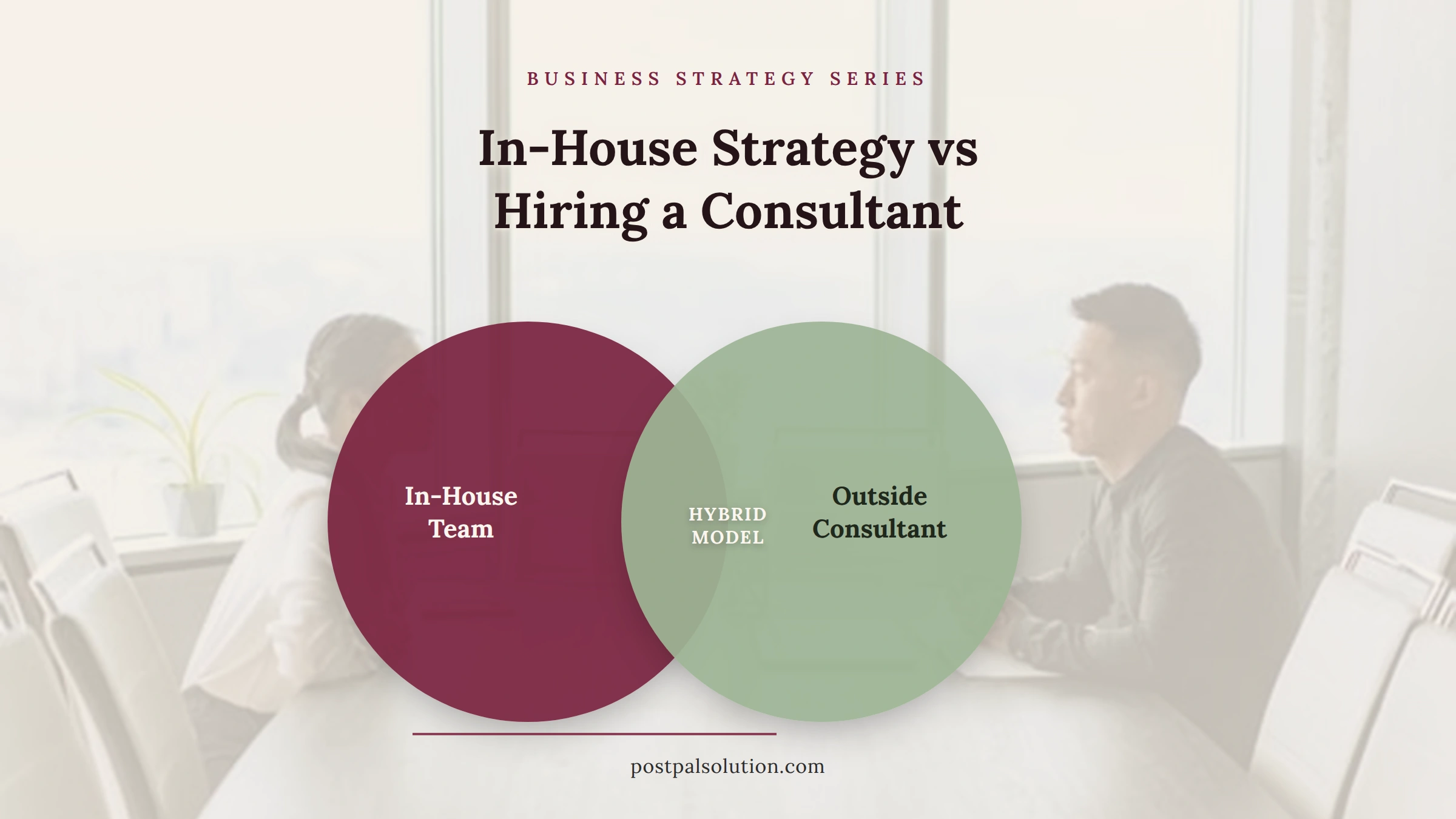
In practice it's not really a choice, between one thing or the other. Most small businesses that plan carefully tend to use a mix of both approaches. The everyday strategy stays inside the company, where knowing the situation well and acting quickly are important. For the few big decisions each year, ones that are too large too difficult to agree on or too new, the business brings in a consultant. This way they get help when it’s needed most.
This also solves the cost objection. A single strategy session a year or two, spaced around the moments that actually call for it, costs far less than adding outside strategy support as an ongoing expense, and it still gives you the objectivity boost when it counts.
How PostPal's Business Strategy Packages Fit In
PostPal built its business strategy services around exactly this hybrid pattern. The Business Strategy Basic package is priced for a single, focused session when you need an outside read on one decision. The Business Strategy Growth package goes further for businesses working through a bigger shift, like a repositioning or a multi-quarter roadmap. Full pricing and package details are on our pricing page.
Conclusion
In-house planning and outside consulting are not really rivals. They are two tools that handle different issues. Do the choices inside where quickness and understanding matter most. Bring in a consultant when the importance of the decision, a standstill or missing perspectives need a new way of looking at things. Not sure which side of that line your next choice is on? A single meeting, with PostPals business strategy team can usually help you figure it out in an hour.
Disclaimer:This article is, for informational purposes and should not be treated as formal business, financial or legal advice. Every business situation is different so talk with an advisor or consultant before making major strategic or financial decisions.
Frequently Asked Questions
Is it cheaper to build strategy, in-house or hire a consultant?
Can a small business really afford a strategy consultant?
What can an outside consultant see that my own team can't?
Does hiring a consultant mean my team stops making strategy calls?
How do I know if my business has outgrown in-house planning?
Can I combine in-house planning with occasional consultant sessions?