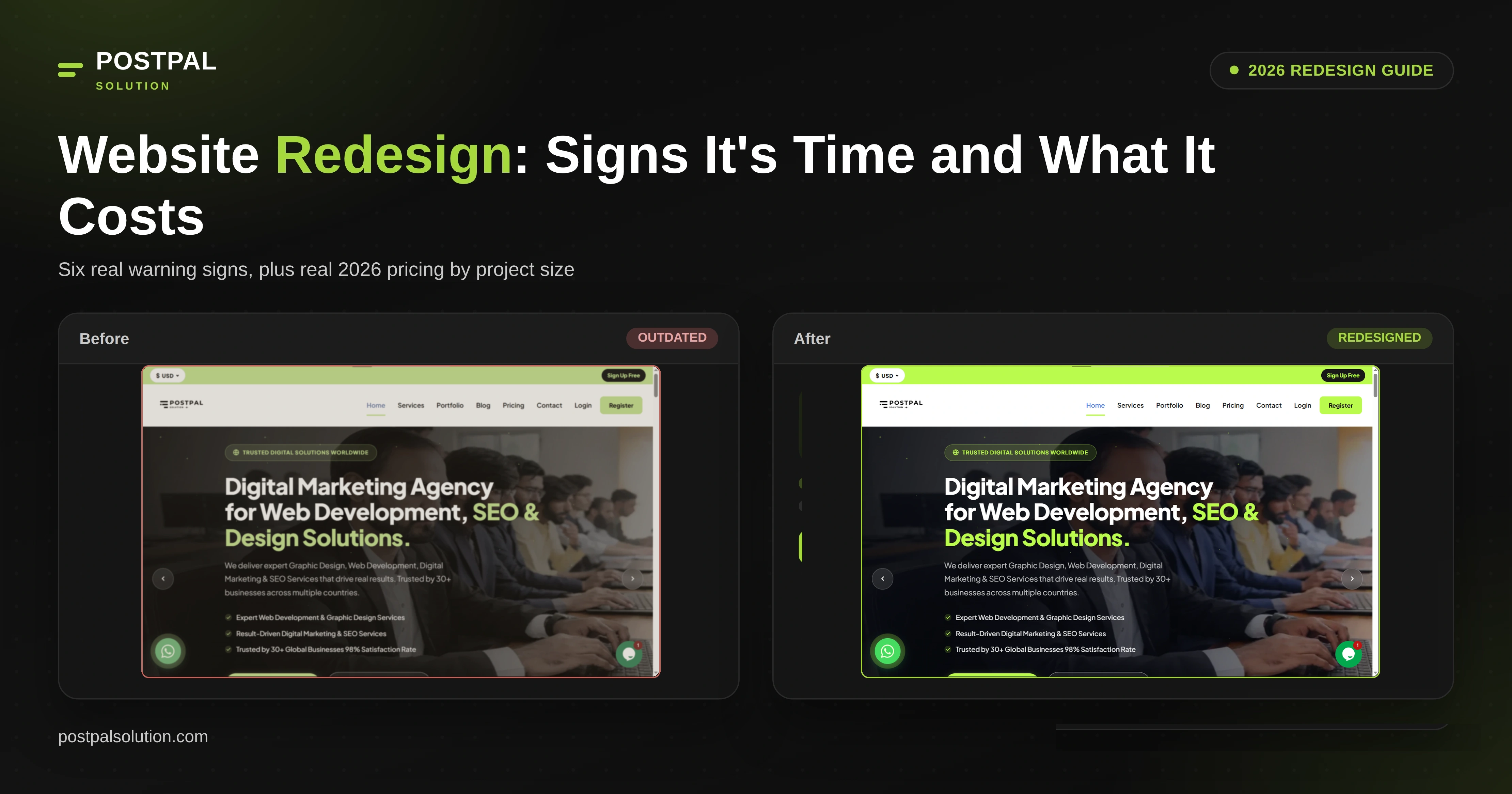
There’s a specific moment a lot of business owners recognize immediately: you’re about to send your website link to a potential client, and you hesitate. Not because the business isn’t good, but because the site doesn’t represent it anymore. That hesitation is usually the real signal, more reliable than any single metric on its own.
This guide covers the concrete signs that a redesign is actually justified, what one costs at different levels of scope, and how to avoid the two most common ways redesign budgets spiral into scope creep and a botched migration that quietly tanks the SEO you already had.
Six Signs It’s Actually Time

Your bounce rate is climbing without an obvious reason. A bounce rate meaningfully above what’s typical for your industry, especially on pages that used to perform fine, usually means something changed in visitor expectations that your site hasn’t kept up with.
Mobile visitors are having a worse experience than desktop visitors. With most web traffic now coming from phones, a site that merely “works” on mobile instead of being built for it is quietly losing more than half its potential audience.
Organic traffic or rankings are falling. Search engines like fast, technically clean, mobile-first sites. A slow bleed in rankings can occur long before anyone notices the design looks dated due to an aging structure, slow load times, or bad Core Web Vitals scores.
Your brand has moved on, and the site hasn’t. New logo, new messaging, new service lineup, same old website. Visitors notice the mismatch even if they can’t articulate why something feels off.
The CMS is holding you back more than it’s helping. If publishing a simple update requires calling a developer, or the backend feels fragile and outdated, that’s an operational cost as much as a technical one.
You’d hesitate to share the URL in a sales conversation. This one’s subjective, but it’s rarely wrong. If the site doesn’t reflect the business you’re actually running today, that gap costs you deals you’ll never trace back to the website.
One of these alone might just need a targeted fix. Several together is usually the point where a proper redesign becomes the cheaper option, not the expensive one.
What a Redesign Actually Costs
 For an exact number based on your current site and goals, see our 2026 rates by project type before you request quotes.
Redesign Type Typical Cost (USD) What It Covers Visual refresh $200–$1,000 New colors, typography, imagery on existing structure Small business redesign (5–15 pages) $750–$3,500 Full design overhaul, mobile optimization, basic SEO cleanup Mid-size business redesign (15–40 pages) $3,000–$12,000 Custom UX work, CMS updates, content restructuring,
integrations Enterprise/complex redesign $12,000+ New platform architecture, large-scale content migration,
compliance work
As a rule of thumb, a redesign generally runs 30–70% of what building the same scope from scratch would cost, since some existing content, structure, and assets can carry over. The variable that moves this the most isn’t visual polish; it’s how much genuine UX work is involved: user journey mapping, navigation restructuring, and conversion-focused rework consistently deliver the highest return, and consistently get skipped by the cheapest quotes.
The Part That Quietly Wrecks Redesign Budgets
Two things blow up more redesign projects than anything else. The first is scope creep: “redesign the website” means something different to everyone in the room until it’s written down. A founder pictures the whole site, blog, and client portal; the agency quotes the homepage and main pages. Neither side is lying; nobody defined it. Get the scope written down before a number gets attached to it.
The second is SEO migration done carelessly. If your current site earns organic traffic, a rushed redesign can wipe out a meaningful share of it within weeks: broken redirects, changed URLs, disappearing metadata. Proper redirect mapping and a technical SEO check before and after launch aren’t optional if search traffic matters to your business; it’s cheap insurance against undoing years of ranking progress in one deployment.
Is It Worth It?
The honest way to answer this is to price the cost of not doing it. If your site converts even one percent better after a redesign and you’re getting meaningful monthly traffic, that improvement alone often pays back the investment within months before counting the harder-to-measure gains in brand credibility and reduced support requests from confused visitors. Our pricing breakdown by redesign tier can help you estimate your own payback period before you commit.
Conclusion
A redesign is worth treating as an investment decision, not a cosmetic one. The businesses that get the best return are the ones that scope it around real signals (bounce rate, mobile experience, brand mismatch) rather than “it’s been a while.” Get the scope written down, protect your SEO through the migration, and the number you pay stops feeling like a gamble.
If your site is showing a few of these signs, PostPal Solution can audit it and tell you honestly whether you need a full redesign or something smaller. Visit our Web Design & Development service page to get started, or check current redesign pricing to see where your project would likely land.
Disclaimer: The prices and time frames talked about in this article are rough ideas based on what was happening in the market in 2026 and what normally happens in a project. What you actually pay will depend on what shape your website is in now, how much work needs to be done to make it easy for people to use, and how complicated everything is. This means the prices we talked about might not be what you pay. This article is just to give you some information and does not mean we are promising to do the work for a price. If you want to know how much your project will cost, you should contact PostPal Solution directly.
Frequently Asked Questions
How do I know if I need a full redesign or just a refresh?
How much does a website redesign cost in 2026?
Will a redesign hurt my search rankings?
How often should a website be redesigned?
What’s the biggest mistake businesses make when budgeting for a redesign?