Most SEO case studies either skip the boring parts or bury you in jargon. This one doesn't. Here's exactly what happened, week by week, when a brand-new local business site went from buried on page 4 to sitting on page 1 for its most important keywords in six weeks, not six months, without any shortcuts that would put the results at risk later.
Six weeks is fast for SEO, and it's worth being upfront about why: this was a local, low-to-medium competition niche on a site with no history to overcome, which is close to the best-case scenario for speed. It's a useful example of what focused execution can do, not a promise of the same timeline for every business see our realistic timeline guide below for what's typical in tougher, more competitive markets.
The Starting Point
|
Detail |
Status at Week 0 |
|
Website age |
Brand new (under 3 months old) |
|
Primary keyword rankings |
Page 4+ or not ranking at all |
|
Monthly organic sessions |
48 |
|
Indexed pages |
6 |
|
Backlinks |
Essentially none |
The client came in with a website that looked professionally built and polished. But it wasn't showing up in search results at all. That gap, between how a site looks and how well it actually performs, is something that often surprises business owners. The client's website was a clear example: professionally built, but with zero organic visibility. If a site doesn't have a solid SEO foundation, it's still not going to be found by people searching online. The difference, between how a website looks and how well it actually works is something that often surprises business owners. The client's website was an example of this. It was professionally built, but it had zero organic visibility.
The Challenge
The topic was local and not too hard to get into. There were companies doing well so being seen would need real effort. It wasn't so full that it was impossible to make a move in a short time. The site had no content beyond basic service pages, no backlinks, and several technical issues: slow load times, missing metadata, and thin content, that gave Google very little reason to rank it over established competitors who'd been online for years.
There was also some deadline pressure. The client needed to start seeing leads within two months. This was to justify continuing the investment. It shaped how the campaign was planned. The important work was done first. It was not spread out evenly over time.
The 6-Week Roadmap

Weeks 1-2: Foundation
Every campaign like this starts with the unglamorous part. A full technical audit surfaced the page speed and crawl issues, all fixed before anything else began compressed images, cleaned-up code, and a handful of broken internal links that had been quietly confusing both users and search crawlers. Keyword mapping identified the dozen or so terms that actually mattered for the business, prioritized by realistic competition level rather than search volume alone chasing a high-volume keyword the site had no chance of ranking for would have wasted the entire campaign on a goal that was never reachable in this timeframe.
Weeks 2-3: Content
Core service pages were rewritten from scratch around the mapped keywords, structured answer-first from the beginning a direct answer near the top of the page, supporting detail below it. That structure matters for ranking today and, as a secondary benefit, is exactly what makes a page easier for AI systems to cite later once it earns enough authority to be a candidate. Two supporting blog posts also went live during this window, targeting adjacent long-tail questions the core service pages didn't fully answer.
Week 3: Authority
We focused on building links in the local area. This included getting our name listed in directories and getting links from other local websites and community groups that really wanted to link to us. This part of the process is usually the hardest and takes the most time. A lot of companies might skip this step to save time and money. If we had skipped it, it would have taken a lot longer to get results, since search engines like Google use links to figure out who should be at the top. So building these links was a key part of our local link building push and our whole campaign.
Weeks 4-6: Refinement and Payoff
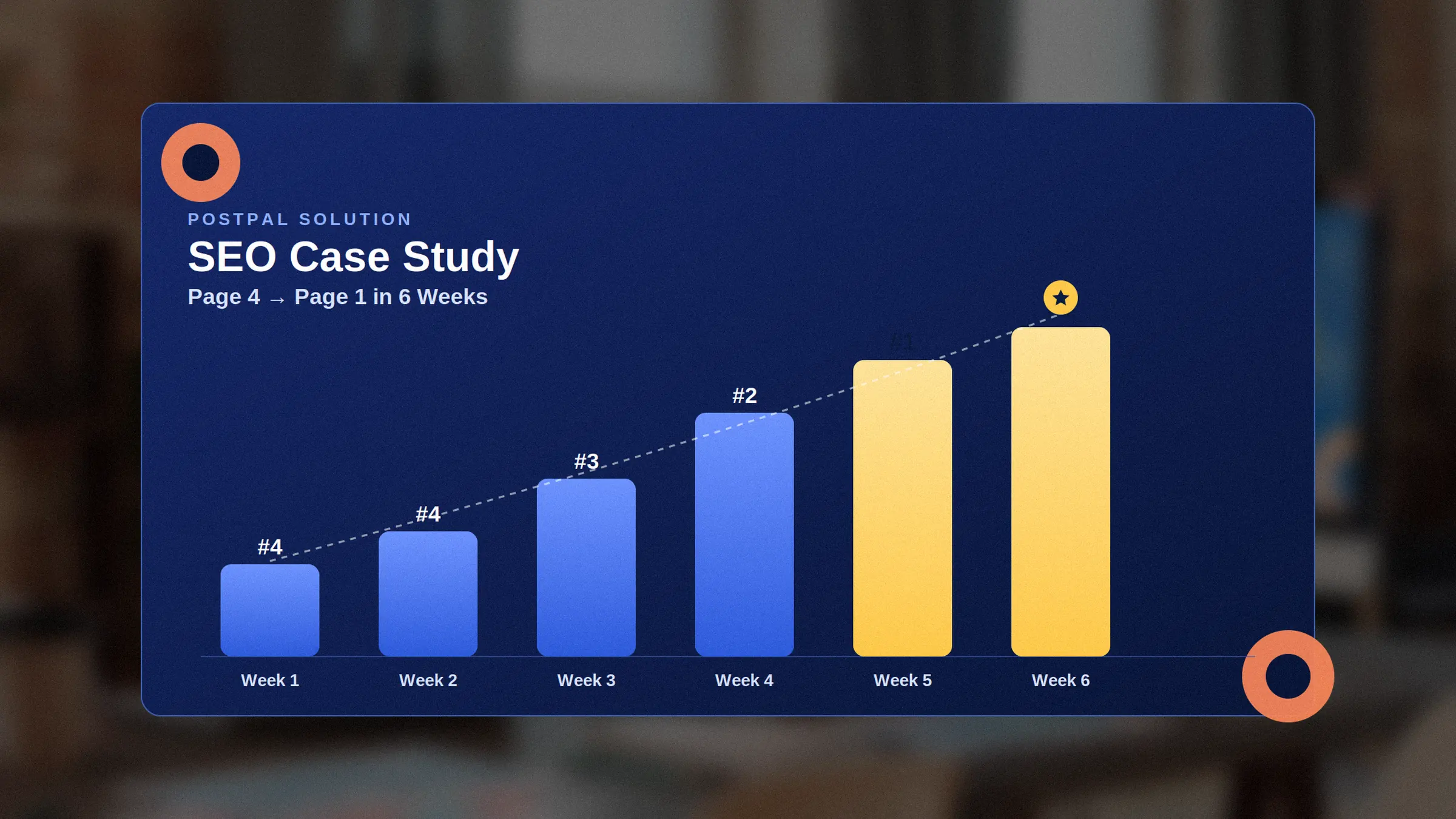
The remaining weeks were spent monitoring Search Console and fixing issues as they came up. Two more pieces of content were added, targeting related long-tail terms surfaced through Search Console data. These new pieces were related long-tail terms, in Search Console. By the end of week 5, the primary keyword cluster was moving up to positions 15 through 20. Then by week 6 the primary keyword cluster had reached page 1. The Search Console showed that the impressions were going up for every tracked primary keyword cluster. This was not just for the primary keyword cluster we were targeting. It was a sign that the website's overall authority with search engines had really gotten improved. The website wasn't just getting lucky with one ranking for one keyword cluster.
The Results

Organic sessions went up from 48 to 365 each month, a 7.6x increase. Indexed pages almost multiplied by four as new content became available. Most important of all, the site went from producing zero organic leads to about 12 each month by week 6 with that number still climbing in the months that followed. None of these numbers appeared at once. Search Console showed weekly progress instead of one big sudden increase. This is usually a stronger signal than a quick, unexpected spike would have been.
Why It Worked
- Realistic keyword targeting: going after winnable terms instead of the highest-volume ones meant faster, real movement instead of months chasing an unrealistic goal that would have shown nothing for the client to see.
- Technical fixes came first: content and links can't do their job on a slow, poorly structured site fixing the foundation early let everything after it actually work instead of fighting an uphill battle.
- Consistent weekly execution: nothing here was a single big push it was steady, planned work every week without long gaps that would have let momentum stall out.
- Local link building wasn't skipped: this is the part cheap SEO packages cut first, and it's usually the difference between six weeks and six months.
Is This Typical?
Honestly, no and any agency implying every campaign moves this fast should raise an eyebrow. This result sits at the fast end of what's realistic, helped by low-to-medium competition and a clean technical foundation from day one. A national brand in a crowded industry, or a site recovering from a previous penalty, would follow a very different timeline even with identical effort and skill applied to it. Our realistic SEO timeline guide explains what you should expect in more competitive areas. In these situations, you might see some progress within 3 to 6 months. Full results could take between 6 and 12 months. This is the common range for these kinds of markets.
Conclusion
This campaign worked because the fundamentals were done in the right order technical health first, realistic content and keyword targeting next, then the link building most agencies skip. Not every business will see page 1 in six weeks, but every business can benefit from the same disciplined approach behind it. Take a look at PostPal's SEO Optimization service to see how a similar plan could be scoped for your business, or check out the full Digital Marketing & SEO Services guide for how SEO fits alongside your other channels.
Disclaimer: This case study is a sample that shows how things might work. It is made up of information from campaigns in 2026. It does not show what will definitely happen. Every result is different. The industry matters. The competition matters. The history of the website matters. How things are done matters.
Frequently Asked Questions
Can every business realistically expect page 1 in 6 weeks?
What made the biggest difference in this campaign?
Did paid ads play any role in these results?
How much did a campaign like this typically cost?
What happened after week 6?