If you have asked people for price estimates, you know the issue. One company says it costs $1,000. Another company says it costs $14,000. A freelancer on Fiverr says he can do the job by the weekend for $250. We have three prices, one job, and no way to know which price is fair. That gap isn't an accident, and it isn't agencies overcharging or underdelivering at random. It comes down to what's actually included in the number: the design work, the platform, the content, the SEO groundwork, the support after launch. Two businesses can ask for "a website" and walk away needing completely different things, and the price tag reflects that even when the brief on paper looks identical.
We made this guide because we have talked to many really confused business owners. Now we want to help you. We will give you answers about the cost of things in 2026. We will help you figure out if you should get a custom build or use something like WordPress. We will tell you what sets one company apart from another so you can avoid hiring someone you'll regret later. We will also tell you how long each type of project usually takes. By the time you finish reading this, you will know enough about 2026 pricing and custom builds, and WordPress to look at any quote you get and know if it is fair or not.
What You'll Learn
1. How Much Does Custom Web Development Cost in 2026?
2. Custom Website vs WordPress: Which Is Right for Your Business?
3. How to Choose a Web Development Agency (Red Flags to Avoid)
4. Web App vs Website: What Does Your Business Actually Need?
5. E-commerce Website Development: Cost, Timeline & What to Expect
6. Website Redesign: Signs It's Time and What It Costs
7. Freelancer vs Agency for Web Development: Pros and Cons
8. Website Maintenance & Support Packages Explained
9. Case Study: 65% Conversion Lift From a Redesign
10. How Long Does It Take to Build a Business Website?
Comparison at a Glance: Where Your Budget Actually Goes

Comparison chart of website project costs by type for 2026, from DIY builders to enterprise platforms
Project Type Typical Range
(USD) Typical Timeline Best For Template-based site $250–$750 1–2 weeks Quick online presence, tight budget Custom business
website $750–$4,000 3–6 weeks Most small-to-mid businesses that
need real conversions E-commerce store $1,500–$8,000+ 4–8 weeks Businesses
selling products online Custom web
application $4,000–$25,000+ 2–5+ months Portals, dashboards, logins, custom systems Enterprise platform $25,000+ 5+ months Large organizations,
heavy integrations
PostPal is a Pakistan-based team serving clients in 50+ countries, which lets us price well below typical US/UK agency rates for the same quality of work. Ranges above are indicative for 2026 and will vary by scope and design depth; ask us for a project-specific quote.
1. How Much Does Custom Web Development Cost in 2026?
"It depends" is the honest answer, but it's also useless if you're trying to set a budget. Working with a Pakistan-based team, a solid custom business website proper design, a working CMS, basic SEO baked in usually falls somewhere in the $750–$4,000 range, well below what the same scope costs with a US or UK agency, with simpler template-based sites starting much lower and larger custom builds going higher.
What actually pushes a quote up isn't the number of pages. It's how many of those pages need a genuinely unique layout, how much original design and copywriting the project needs, and whether there are technical extras integrations, payment gateways, animation sitting underneath the surface. One thing worth knowing before you compare quotes: agencies that handle both design and development in-house usually come in cheaper overall than hiring two separate vendors, simply because nothing gets lost translating between them.
Read the full guide: How Much Does Custom Web Development Cost in 2026? (Pricing Breakdown)
2. Custom Website vs WordPress: Which Is Right for Your Business?
WordPress is widely used, easy to get started with, and most content creators already know how to use it, plus it's cheap to set up initially. But being cheaper upfront doesn't mean it stays cheaper over three years. A website that is made from scratch can load faster. It can also handle it when the business gets bigger. You do not have to deal with the problems that come with using a lot of tools on a WordPress site. WordPress sites often have a lot of tools and these tools can sometimes cause problems, with each other. They also need to be updated all the time.
The website that actually works for you depends on how stuff your team wants to handle by itself how special the things it can do need to be and how long you plan to keep the website before making a new one. If you have a blog with a lot of content or a site that needs to be updated WordPress is usually a good choice. If you have a website that is meant to get people to buy things or if it has to do things that are not normal, like letting people book things or showing them special information it is usually better to make it from scratch right from the start.
Read the full guide: Custom Website vs WordPress: Which Is Right for Your Business?
3. How to Choose a Web Development Agency (Red Flags to Avoid)
A large share of outsourced web projects run into real trouble missed deadlines, miscommunication, code that needs to be redone. None of that is inevitable. It is almost always avoidable if you vet the agency properly before signing anything, instead of choosing based on the cheapest quote or the nicest portfolio screenshots.
When you are looking for an agency to work with there are some things you should pay attention to.
You need to find the agency for your business and that means you have to be careful. The clearest warning signs to watch for are agencies that jump into making mockups without asking a question about your business goals. This type of agency is not a choice because they do not care about what you want to achieve with your business, which is your business goals. Another warning sign is an agency that can only show you screenshots of live sites with real results. You want to see what the agency can actually do not what they can draw, because that's not the same thing. Also be careful of pricing that's vague until you are already committed. This can be a sign that the agency is not being honest with you about how much things will cost, which is something you need to know. If the agency does not mention what happens after launch unless you bring it up yourself that is a sign too.
A good team will usually ask you questions than you expected about your business goals because they want to know what you want. A team worth hiring will tell you their pricing model upfront so you know how much things will cost. A good team will treat SEO and accessibility as part of the build than something they add later because they care about your website. This means they care about making sure your website is easy to use and can be found by people who are looking for it which is the point of having a website. A team worth hiring will make sure your website is good, from the start not something they fix later because they want your website to be the best it can be which is your business website.
Read the full guide: How to Choose a Web Development Agency (Red Flags to Avoid)
4. Web App vs Website: What Does Your Business Actually Need?
A website shares information with people. A web application allows them to take action like log in manage information complete a purchase or interact with a system that knows who they are. This difference is important for your budget. A simple marketing website costs less than a full web application, with user logins a database and control panels. The web application costs more because it needs backend work.
Most business owners who think they need a "web app" actually need a well-built website with a couple of smart integrations wired in a booking widget, a CRM connection, a payment form. Real web app territory belongs to businesses building an actual product: a customer portal, an internal operations tool, or a platform where people create accounts and keep coming back. Getting this call right early saves you from either overpaying for engineering you don't need or underbuilding something that quietly needed to be custom software from the start.
Read the full guide: Web App vs Website: What Does Your Business Actually Need?
5. E-commerce Website Development: Cost, Timeline & What to Expect
E-commerce pricing swings harder than almost any other category, because the same size catalog can come back as a modest quote on a standard WooCommerce or Shopify theme, or a much higher one on a fully custom build. A basic store typically starts around $1,500, while a custom platform with payment gateways, advanced filtering, or inventory integrations can run several times that.
Timeline typically runs 6–12 weeks for a mid-size store, longer if inventory management or multiple sales channels are involved. Stores that get the most out of the investment treat product photography, checkout experience, and mobile speed as part of the original project scope not something priced in after the site is already live.
Read the full guide: E-commerce Website Development: Cost, Timeline & What to Expect
6. Website Redesign: Signs It's Time and What It Costs
A redesign generally costs 30–70% of building a brand-new site, depending on how much of your existing structure and content can carry over. Most businesses that need one are seeing the same handful of signs: bounce rates creeping up, a site that looks visibly older than competitor's, a mobile experience that lags noticeably behind desktop, or a brand that's grown past what the current site represents.
The redesigns that actually pay off start with an audit of what's driving or losing leads right now, before anyone touches a layout. Done that way, a redesign becomes one of the highest-return investments available, since it improves the performance of traffic you are already paying to bring in.
Read the full guide: Website Redesign: Signs It's Time and What It Costs
7. Freelancer vs Agency for Web Development: Pros and Cons
Freelancers usually cost 30–50% less than agencies in Pakistan and offer direct, one-on-one communication and faster turnaround on well-scoped work. Agencies charge more but bring something freelancers usually can't: redundancy. If one person gets sick or takes another job mid-project, the work keeps moving.
As a rough guide, freelancers make sense for simple, clearly defined sites on a tight budget. Agencies earn their higher price on anything that needs strategy, design, development, and SEO actually working together instead of getting stitched together after the fact. The real risk with freelancers usually isn't skill it's bandwidth and what happens if they disappear mid-project.
Read the full guide: Freelancer vs Agency for Web Development: Pros and Cons
8. Website Maintenance & Support Packages Explained
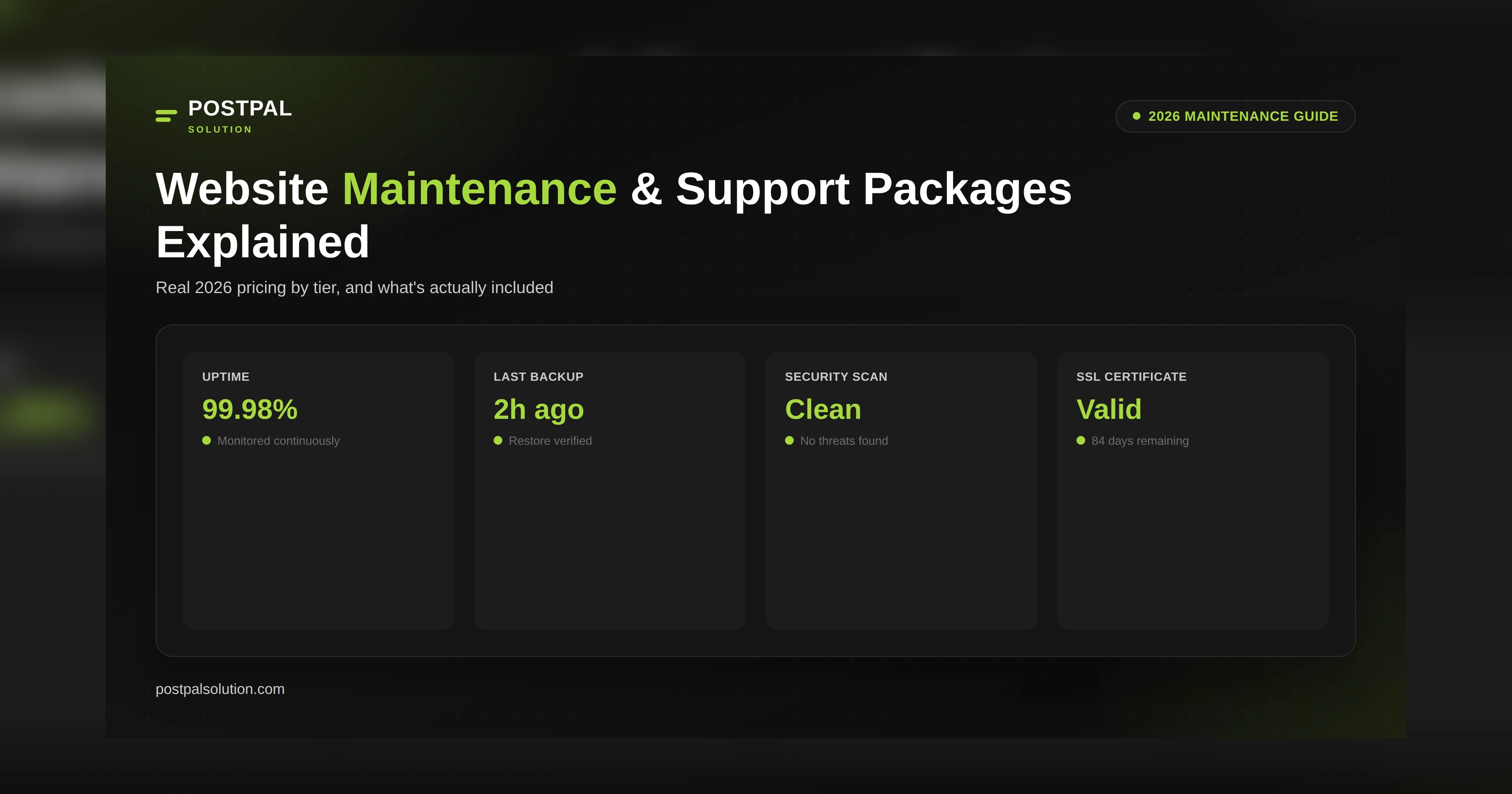
A website that is properly taken care of needs someone to take care of updates, backups, uptime monitoring and security all the time not just when it is first built. Most small businesses that work with PostPal set aside $25 to $100 every month for this. This is a lot less than what agencies, in the West charge. Generally it costs around 15 to 20 percent of what it cost to build the website in the place to maintain it every year. If you do not do maintenance you are not really saving money you are just going to have to pay for it when there is an emergency. Usually emergencies cost a lot more than if you had just paid for maintenance in the first place.
Read the full guide: Website Maintenance & Support Packages Explained
9. Case Study: How a Website Redesign Increased a Client's Conversion Rate by 65%
Numbers speak louder than promises. This case study breaks down a real redesign project, what the initial audit uncovered on both the design and technical side, the changes that followed, and the results: a 65% increase in conversions. It's worth reading if you want to see what a well-executed redesign can actually deliver. You should read it if you want to know what a good redesign can achieve. The title of the case study already shows a 65% conversion lift. It's worth reading for results of a redesign done well.
Read the full guide: Case Study: How a Website Redesign Increased a Client's Conversion Rate by 65%
10. How Long Does It Take to Build a Business Website?
Timeline tracks complexity fairly closely. A basic 5–10 page brochure site usually takes 2–4 weeks. A mid-size corporate site with more pages and custom design work runs 4–8 weeks. E-commerce builds take 6–12 weeks. Full web applications or portals run 3–6 months or longer. Across the industry, the average agency project takes around 9 months start to finish once you factor in scope changes, revision rounds, and content production though most small business sites move a lot faster than that average implies.
If someone promises a fully custom, complex site in a week or two, they're either overselling the scope or planning to cut corners you won't notice until later. A realistic timeline, stated clearly upfront, is one of the better signs an agency knows what it's doing.
Read the full guide: How Long Does It Take to Build a Business Website?

Ready to Move Forward?
If you've made it this far, you already know more about realistic pricing, agency red flags, and timelines than most business owners do when they start requesting quotes. The next step is turning that into an actual scoped estimate for your project instead of a generic package price.
PostPal Solution has built and redesigned websites for clients across 50+ countries, and every project starts with understanding what your site needs to actually do before anyone touches a mockup. If you want to see what a custom quote looks like for your business, head to our Web Design & Development service page to book your project directly. No pressure, just a clear breakdown of scope, cost, and timeline.
Conclusion
A website is one of the only business assets that works around the clock, and the gap between one that converts and one that just sits there almost always comes back to the decisions covered in this guide the platform you build on, the partner you hire, and whether the project is scoped around your actual goals or a generic template. Use the ten linked guides above to go deeper on whichever decision is in front of you right now, and come back to this page as your reference point as you move through the process.